Deep River
Client
Personal Project
Roles
Year
2026
Team
Solo

1 / 5
Swipe to navigate
Context
There is a category of American music that did not ask to exist.
Negro spirituals were not composed — they were wrung out. Born in the fields, the meeting houses, and the dark margins of American slavery, they were the only sovereign territory enslaved Black Americans were permitted: the interior life, set to song. Songs like Deep River, Go Down, Moses, and Swing Low, Sweet Chariot encoded longing, resistance, faith, and grief into melodies that outlasted the conditions that created them. They became the root system of American gospel, the blues, and jazz — an inheritance given to the world by people the world refused to recognize as fully human.
And yet, more than a century after emancipation, these songs have no permanent, dignified home on the internet.
What exists today is scattered — buried in university PDFs, locked behind academic paywalls, corrupted by misattribution, or flattened into pages that strip the weight from every word. The tradition survives. The scholarship surrounding it does not reach the people who need it most.
Deep River is my attempt to build the archive this tradition deserves — an education-first digital archive of Negro spirituals, centered on the communities for whom these songs are not historical artifacts but living inheritance.
The Challenge
The problem is not a lack of information. Scholars have spent generations documenting this tradition — its origins, its coded meanings, its role in the Underground Railroad, its transformation into the foundation of American music. The research is rich. The problem is access, architecture, and respect.
Existing archives fall short
Academic databases hold rigorous scholarship but sit behind paywalls. The people most connected to this tradition — Black church communities, high school students, families tracing ancestry — are the least likely to have institutional access.
Context stripped away
Streaming platforms and lyrics sites carry the words but not the weight. A song appears as a tracklist item, stripped of its antebellum geography, its era, its thematic significance, and the collectors who risked to preserve it.
No multi-dimensional browsing
Nowhere can you navigate Negro spirituals by thematic element, geographic region, antebellum period, and scholarly collection simultaneously. The tradition is deeply contextual — but no interface honors that complexity.
The centering problem
Most existing resources were written for an outsider gaze — framing these songs as historical curiosities rather than as living cultural inheritance belonging, first and foremost, to Black Americans.
How might we build a freely accessible, education-first archive that centers Black American ownership of this tradition — one that treats scholarship and community as equal priorities?
Design Philosophy
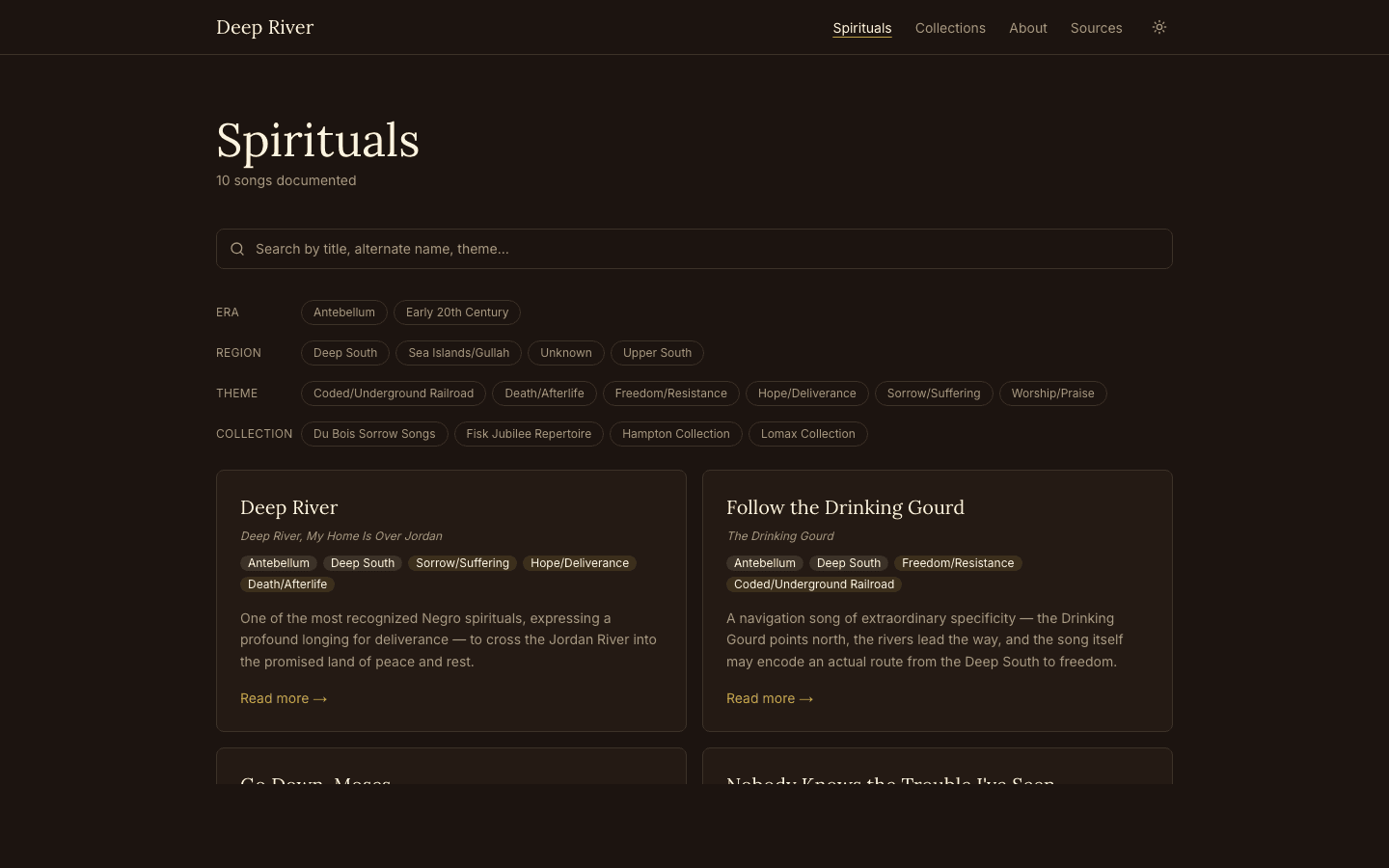
The visual language of Deep River is not decorative — it is an argument about what this tradition deserves to be treated as.
A Warm Dark Aesthetic
The palette — deep charcoal backgrounds, warm amber and ochre accents, cream-toned type — evokes the conditions in which so much of this music was actually made: candlelit gatherings, night-time meetings, the hush of voices not meant to be overheard. This is not a "dark mode." It is the primary experience. It says: this is a place of weight and care, not utility.
Typography as Reverence
Serif type at every level — from the wordmark to the body copy — anchors the archive in literary tradition. This is a place of scholarship and memory. The type should feel like a book, not a dashboard. Every song title is set with the gravity of a primary document, because that is exactly what it is.
No Friction, No Gatekeeping
There are no accounts. No paywalls. No "subscribe to read more." Every spiritual, every scholarly citation, every piece of contextual writing is free and immediately available — to the professor, to the teenager, to the grandmother who wants to know where her grandmother's church songs came from. The design reflects the access policy: nothing is hidden.
Technical Architecture
Deep River is built to last and built to perform. Every technical choice is as deliberate as the design ones.
MDX-Powered Spiritual Entries
Each of the 10 spirituals in the archive lives as a structured MDX file. Frontmatter encodes validated metadata — era, region, thematic elements, and scholarly collection — while the MDX body renders the full entry: lyrics sourced from pre-1928 public domain collections, historical context, cultural significance, and embedded scholarly notes. Adding a new spiritual means writing one file. The archive is a filesystem.
Static Generation for Near-Instant Access
Every page in Deep River is statically generated at build time with Next.js 15. There is no server computing a response when a visitor arrives. For a project about preservation, this performance characteristic matches the ethos: what is archived is immediately and reliably available. No spinners. No latency. Just the song.
Four-Dimensional Filtering System
The archive is browsable across four independent dimensions — ERA (Antebellum, Early 20th Century), REGION (Deep South, Sea Islands/Gullah, Upper South), THEME (Coded/Underground Railroad, Death/Afterlife, Freedom/Resistance, Hope/Deliverance, Sorrow/Suffering, Worship/Praise), and COLLECTION (Du Bois Sorrow Songs, Fisk Jubilee Repertoire, Hampton Collection, Lomax Collection). These are not decorative tags. They reflect the actual scholarly frameworks used to study this tradition — rendered as a browsable interface.
Tailwind CSS v4 + shadcn/ui Design System
The interface is built on Tailwind CSS v4 with shadcn/ui components. The warm palette is implemented as CSS custom properties — semantic color names that allow the theme to be consistent and maintainable across every component. Light mode is available via a toggle stored in localStorage; the preference persists across visits without a flash of unstyled content on load.
Creative Commons Licensing
Original written content — contextual essays, scholarly annotations, curatorial framing — is published under CC BY-NC-SA 4.0. Lyrics are sourced exclusively from pre-1928 public domain collections. The archive protects its content and the tradition simultaneously: anyone can share and adapt with attribution, but no one can profit from it.
Design Decisions
The Decision
The color scheme is not dark mode. Dark mode is a toggle — a concession to user preference, layered over an assumed light default. Deep River's warm dark palette is the primary experience, the only intended experience. The distinction is intentional.
Why These Colors
The palette — deep charcoal backgrounds, warm amber and ochre accents, cream-toned type — is rooted in the conditions under which this music was actually made. Candlelit gathering houses. Night-time meetings where voices were kept low. The margin between permission and punishment. These were not bright, clinical spaces. The interface should not be either.
Cool or neutral dark palettes carry associations with technology products, developer tools, and entertainment platforms. None of those associations belong here. Warm earth tones — amber, ochre, the color of old paper and fire — carry weight, care, and time. They say: this is not a product. This is a place.
Why It Matters
Color is never neutral. A design that treats a tradition of survival and endurance with the same visual language as a SaaS dashboard is making a statement — even if inadvertently. Deep River's palette is an argument that this archive occupies different cultural territory. The warmth is deliberate. The darkness is deliberate. Together they are the closest a screen can come to honoring the rooms where these songs were first sung.
The Problem It Solves
The richness of the Negro spiritual tradition is inseparable from its context. A spiritual documented in the Georgia Sea Islands carries different historical weight than one from the Upper South Appalachian tradition. A song from the antebellum 1840s sits in a different moment than one recorded during Reconstruction. Existing archives flatten these distinctions. Deep River surfaces them.
How It Works
Each spiritual entry is tagged across four scholarly dimensions at the time of authorship. The filter interface renders these as independently selectable facets — users combine them freely. Filter by THEME: "Coded/Underground Railroad" to trace the tradition of encoded escape narratives. Filter by REGION: "Sea Islands/Gullah" to find the spirituals rooted in the distinctive culture of the South Carolina and Georgia coast. Each combination produces a meaningful, coherent subset of the archive.
Design Decision
The filter panel is persistent — it never disappears while browsing. Because the browse experience is the point. Users should feel they are exploring a collection with real intellectual depth, not just running a keyword search. The 10 songs currently documented are a foundation, not a ceiling; the infrastructure is built to grow.
The Problem It Solves
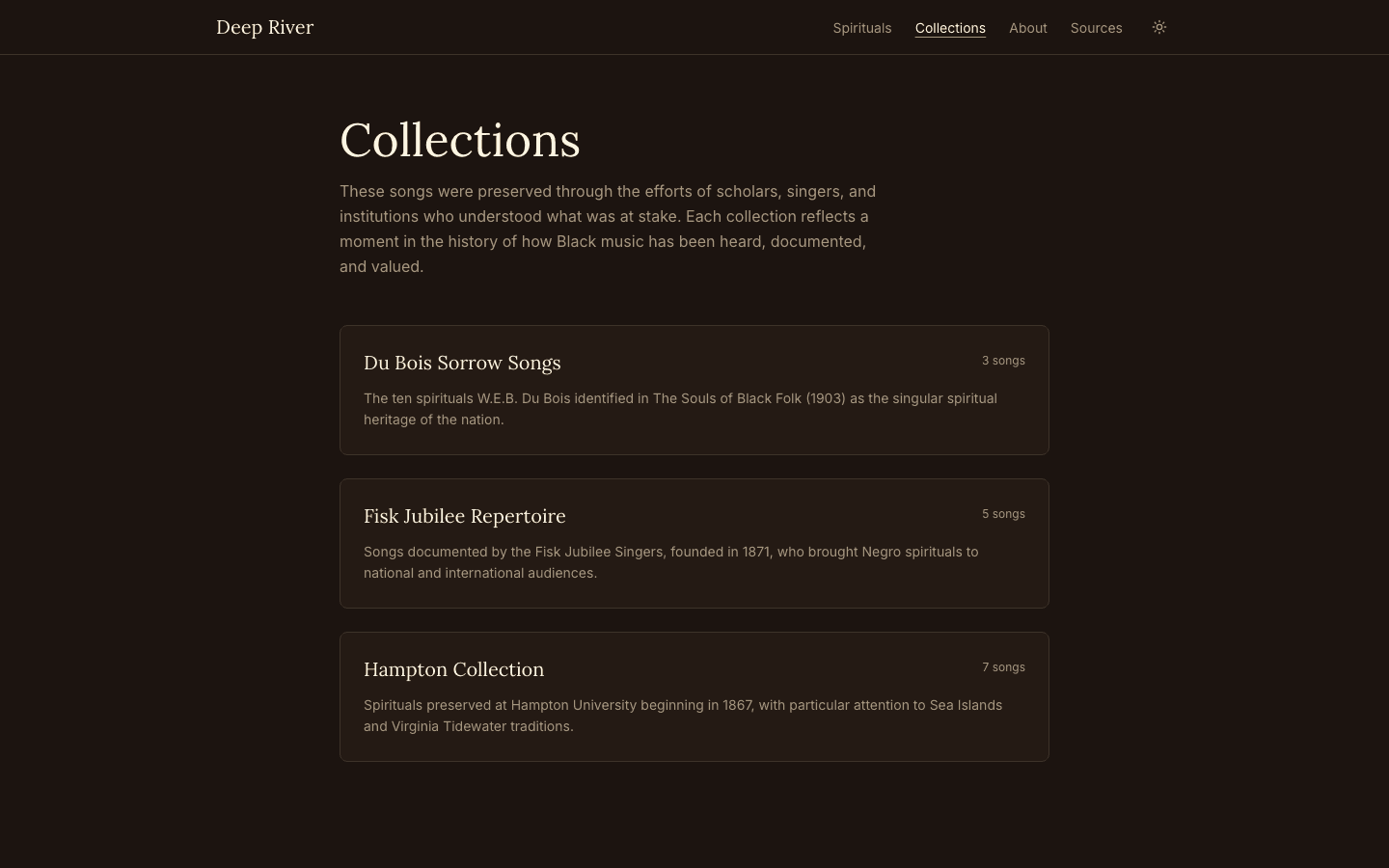
The preservation of Negro spirituals is itself a story with human beings at its center. W.E.B. Du Bois named ten spirituals in The Souls of Black Folk (1903) as the singular spiritual heritage of the nation. The Fisk Jubilee Singers, founded in 1871, brought this music to national and international audiences for the first time. Hampton University began preserving spirituals in 1867 with particular attention to Sea Islands and Virginia Tidewater traditions. John Lomax and his son Alan spent decades recording folk music across the American South for the Library of Congress. These collectors — with all their complexity — are part of how the tradition survived. The archive should honor that history.
How It Works
The "Collection" filter groups spirituals by the scholarly body that documented them. Users can browse the archive as if reading a specific collector's work:
- Du Bois Sorrow Songs — 3 songs W.E.B. Du Bois identified as the nation's spiritual inheritance
- Fisk Jubilee Repertoire — 5 songs from the singers who took this music to the world stage
- Hampton Collection — 7 songs preserved beginning in 1867, anchored in Sea Islands traditions
- Lomax Collection — songs captured across the American South in field recordings
This adds an historiographical layer to browsing: you are not just discovering songs, you are discovering how songs were found, by whom, and when.
The Problem It Solves
On most platforms, a spiritual appears with a title and maybe some lyrics. The metadata that makes it meaningful — when it likely emerged, where it was documented, what it was about beneath its surface words — is simply absent. The result is a catalog, not an archive.
How It Works
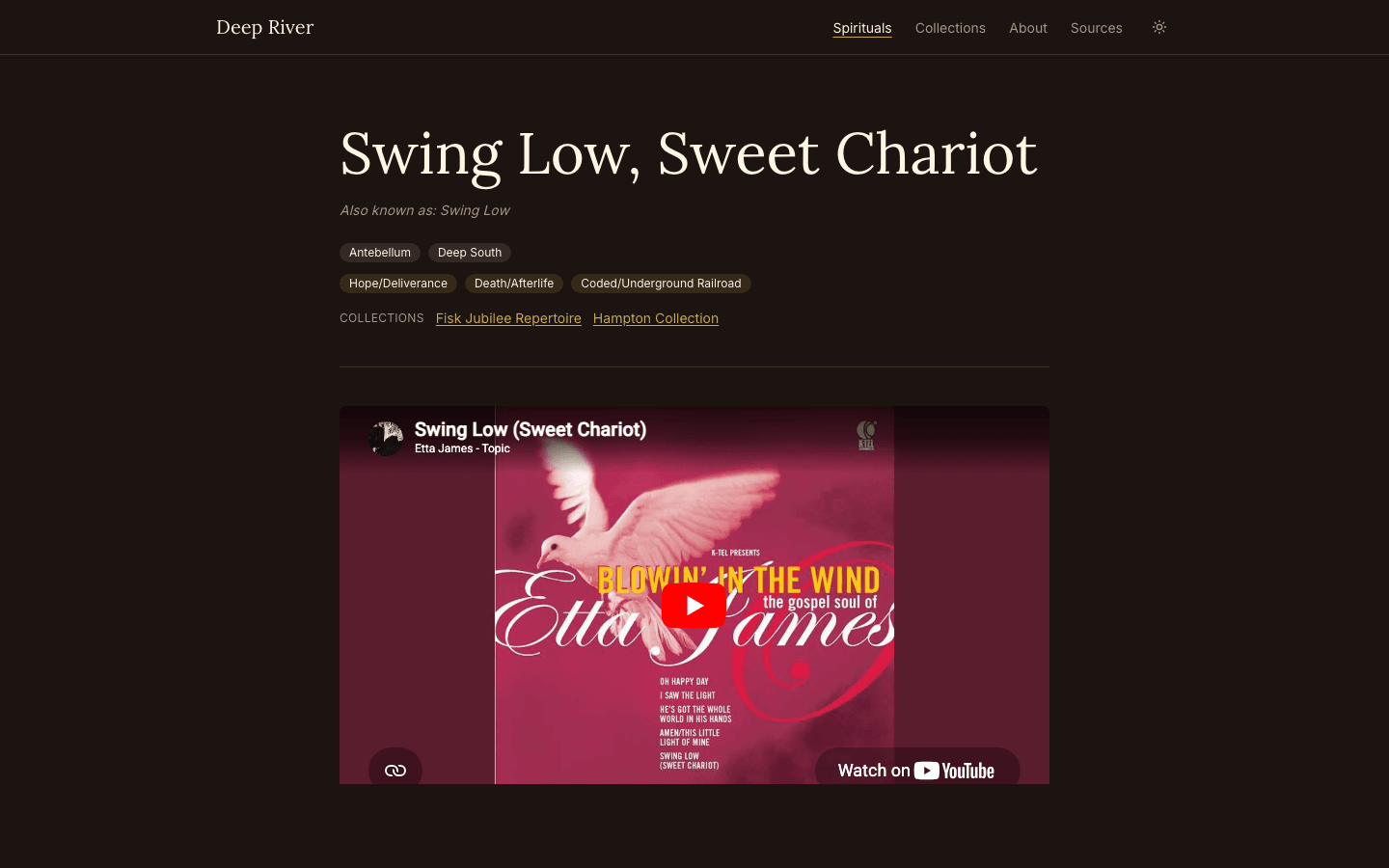
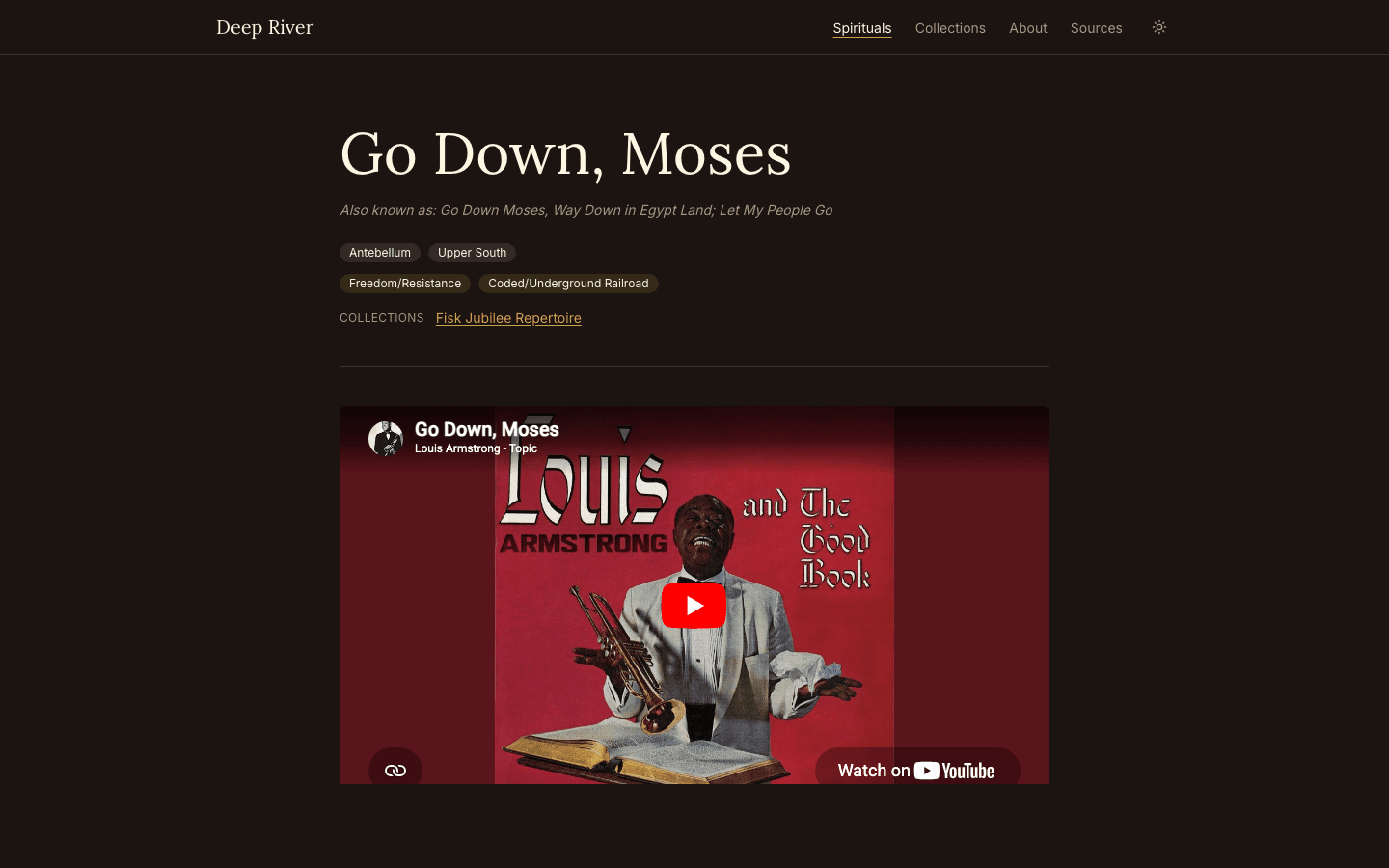
Every entry in Deep River surfaces its full scholarly metadata at reading level:
- Era and Region — antebellum period and geographic origin
- Alternate Names — many spirituals were known by multiple titles across different communities (Deep River, My Home Is Over Jordan)
- Thematic Tags — the coded meanings, religious themes, and resistance traditions embedded in each song
- Collection Lineage — which scholarly collections documented this song and first brought it to wider preservation
This metadata is not buried in a references section. It lives at the top of every entry, visible before the first word of lyric, because context is not supplementary — it is the point.
The Problem It Solves
The internet is full of unsourced claims about Negro spirituals — where they came from, what they meant, who sang them first. Some of this is innocent simplification. Some of it is the accumulated drift of repetition without accountability. Deep River treats citations not as footnotes but as load-bearing structure. If a claim is made about a song's origin, its relationship to the Underground Railroad, or its documentation by a specific collector, that claim needs a source.
How It Works
Scholarly citations are embedded throughout every entry — not collected at the bottom of the page, but woven into the narrative. The goal is a reading experience where scholarship and story are inseparable. When any reader encounters a claim, they can follow the thread immediately. They can go deeper. The citations are not decoration — they are the invitation to keep learning.
Why It Matters
This archive is built for students writing papers, researchers verifying claims, and community members who simply want to understand what they're hearing. The standard of evidence should be the same for all of them.
Impact
What 10 Spirituals Actually Means
The archive currently documents 10 Negro spirituals — each one fully written up, cited, tagged across every dimension, and freely accessible to anyone with a browser. Ten is not a large number by any database standard. But each entry represents hours of research, careful language, and deliberate curation. Each one is a story that now has a home it did not have before. The infrastructure — the MDX architecture, the filtering system, the collections framework — is ready to scale. Ten is a beginning, not a ceiling.
Centering the Right Audience
Deep River centers Black Americans as its primary community — the people for whom these songs are not historical curiosities but living inheritance. At the same time, it is freely accessible to everyone: the student writing a paper, the choir director researching context, the genealogist tracing a family's connection to a specific region, the person who heard a song at a funeral and wanted to understand where it came from. No account. No paywall. No friction between the person and the song.
Performance as a Principle
Static generation means the archive loads near-instantly on any device, on any connection. For a resource meant to be used in schools, churches, and community centers — where bandwidth is not always reliable — this is not a footnote. It is a design principle in action. What is preserved should be preserved reliably.
"Songs, stories, and scholarship of a tradition born from the deepest suffering and the most enduring hope." — Deep River's mission, in its own words.
The work is not finished. It will not be finished for a long time. An archive dedicated to preservation is, by definition, an ongoing act — not a product launch with a ship date. But Deep River is live, it is free, and it is growing. For a tradition that has survived everything the world has thrown at it, a digital home is the very least it deserves.